




My journey into medical billing and coding has shown me how crucial we are in healthcare. Starting out, I blended health information with technology. As a certified coding specialist, I help keep the financial health and data management of medical institutions in check. This ensures that healthcare services are properly billed to insurance.
I’ve always focused on being precise and thorough in my work as a healthcare reimbursement specialist. It feels rewarding to make sure healthcare professionals are paid right and on time. Turning medical services into codes is a big responsibility. It proves how much the industry relies on us.
Going from a beginner to a skilled health information technician has been eye-opening. Now, I can work from anywhere, thanks to remote job options. This flexibility shows how adaptable and vital my role as a medical biller coder is, especially in today’s changing healthcare landscape.
Key Takeaways
- Careers in medical billing and coding are leading the charge in healthcare employment growth.
- The field is increasingly supportive of remote work, enhancing work-life balance and cutting down on travel.
- A health information technician plays a key role in moving towards digital patient records and smooth billing processes.
- To stay relevant in this field, continual learning and adapting to new tech and rules are critical.
- Being a successful healthcare reimbursement specialist means valuing precision, being able to work remotely, and always learning.
Understanding the Role of a Medical Biller Coder
The need for medical billing experts, medical coding professionals, and healthcare coding specialists is growing. These jobs are vital links between healthcare providers, patients, and insurance companies. They make sure medical billing and coding are done right and fast.
What Does a Medical Biller Coder Do?
Being a medical biller coder is key in healthcare. They deal with health insurance claims, patient bills, and quality checks. Their job is to turn complicated medical records into simple codes.
These codes are used for billing and insurance. Accuracy and attention to detail are a must. This makes sure insurance claims and patient records are up-to-date.
Importance in the Healthcare System
If medical coding professionals weren’t precise, healthcare providers might not get paid right. Their work is crucial. They keep operations smooth, follow rules, and make sure everyone is happy.
Skills Required for Success
You need specific skills to succeed in medical billing and coding. Knowing medical terms, being adept at ICD-10, and computer savvy are top needs. Also, being detail-oriented and keeping up with medical laws is key.
There are good schools for those looking to start in this field. For trusted programs and help in starting your career, check out medical coding and billing schools. This helps avoid scams and ensures a quality education.
The sector is set to grow, offering many chances for the right candidates. Being certified, like becoming a Certified Professional Coder (CPC®), improves job outlook. Investing in education and staying current with skills is important.
The Path to Becoming a Medical Biller Coder
Starting a career in medical billing and coding is rewarding but hard. It requires a good education and getting certified. As healthcare changes, we need more skilled billers and coders. They are key in the healthcare payment process.
Educational Requirements
To start, you need to pick a learning path. This could be a certificate, diploma, or an associate degree. These programs last from 4 to 8 months. They teach what you need to know to do well. Going through a good program helps a lot with your career.
Certification Processes
After learning the basics, you must get certified. One important certification is the Certified Professional Biller (CPB)® from the AAPC. It shows employers you know your stuff in medical billing.
Key Training Programs
You should also do specialized training. This training, about 80 hours, gets you ready for the job’s challenges. A good program is shown by how many of its students get their CPB credential.
| Location | Employment per Thousand Jobs |
|---|---|
| Yuba City, CA | 1.21 |
| San Jose-Sunnyvale-Santa Clara, CA | 0.81 |
| Riverside-San Bernardino-Ontario, CA | 1.35 |
| Sacramento–Roseville–Arden-Arcade, CA | 1.69 |
| San Francisco-Oakland-Hayward, CA | 1.18 |
Knowing how to start a career in medical billing and coding is key. These steps get you ready for a great career. They make you a vital part of the growing healthcare world.
Day-to-Day Responsibilities
In my role as a medical billing and coding specialist, I deal with the healthcare payment system daily. My tasks include analyzing medical records for billing and working with insurance companies. Each task requires precision and a deep understanding of medical terms and software.
Coding Medical Procedures
I start by converting complex medical procedures into universal codes. It’s vital because mistakes can lead to claim denials. Correct coding ensures healthcare providers get paid right and keeps the facility financially healthy. I help maintain trust between patients, providers, and insurers.
Submitting Claims to Insurance Companies
After coding, I submit these codes to insurers. This is where the payment process starts. It needs a careful review to meet insurer guidelines. Sometimes, I have to discuss claims with insurers to make sure they’re clear and accurate.
Working with Healthcare Providers
I work closely with healthcare providers, too. I check the information they give me is complete and right. We discuss any issues to make sure codes are assigned properly. This teamwork helps keep billing smooth and lowers claim rejections.

Being good at communicating, thorough, and detail-oriented is key to my job. These skills help me manage my work and could lead to more opportunities in the field.
| Position | Median Annual Salary | Average Hourly Wage |
|---|---|---|
| Medical Billing and Coding Specialist | $48,780 | $23.45 |
| Medical Claims Analyst | Varies with certification ($58,055 – $74,000) | Depends on certification level |
| Health Information Technician | $55,411 | Data Not Specific |
The U.S. Bureau of Labor Statistics predicts an 8% job growth in our field for the next ten years. This shows the job security and growing chances for medical billing and coding professionals.
Challenges Faced in Medical Billing and Coding
Jumping into medical billing and coding comes with unique challenges. It requires resilience and a love for constant learning. These tests sharpen our skills, keeping us ahead in healthcare management.
Keeping Up with Changes in Regulations
The world of medical billing regulations is always changing. For those of us in this field, staying informed is vital. We must adapt to new rules and tech. For example, changing patient data needs during Covid-19 have made accuracy more crucial.
Managing Claim Denials and Rejections
Dealing with claim denials and rejections is a tough part of our job. Knowing the ins and outs of coding rules is key. Yet, simple mistakes like typos can cause delays or rejections. So, finding and fixing these errors quickly is important. It often means we have to be up-to-date with coding practices.
These challenges highlight the complexity and value of our work in healthcare. They motivate us to keep up our skills and to pursue further education. Being a medical biller and coder is a journey that shows the changing and crucial role of healthcare management.
Essential Tools and Software
As a medical coding professional, efficiency is key. We rely on tools and software to manage patient records and claims. These technologies are vital for our work every day.
Popular Medical Billing and Coding Software
The right software is crucial for us, especially for specialists. For example, the 3M™ 360 Encompass System helps turn medical info into accurate codes. It finds the right codes and gives guidelines, making our job easier and more precise.
Encoder programs are essential for coding. They use databases like ICD-10-CM, CPT®, and HCPCS to bill medical services correctly. These programs help us work with less error and more consistency.
The Role of Electronic Health Records (EHR)
EHR systems, such as Epic and Cerner, have changed how we store and access patient data. They keep data safe and allow quick updates. This is great for us because we need up-to-date information to do our jobs well.
Thanks to Virtual Private Networks (VPN), we can safely access EHR systems from anywhere. This is very useful in today’s work from home setups. Having data at our fingertips helps us code efficiently, no matter where we are.
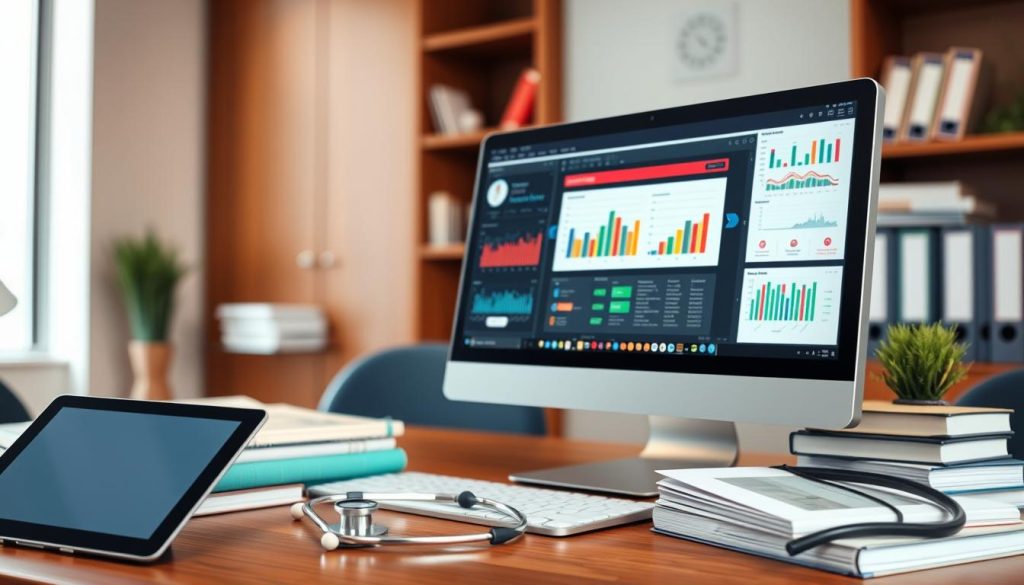
From my experience, these tools greatly improve our workflow. They help with coding and keep us in line with healthcare laws. For anyone starting in medical coding, learning these tools is a must for success.
The Impact of Technology on Medical Billing and Coding
I work in healthcare reimbursement and I’ve seen big changes due to technology in billing and coding. Automation has made tasks easier. Also, the growth of telehealth is changing how we bill services. These changes help both workers and patients.
Automation in the Billing Process
Automation has really changed medical billing. AI helps reduce mistakes a lot. For example, a large hospital saw a 30% drop in errors with AI. This makes billing for patients more accurate and efficient.
Telehealth’s Influence on Coding
Telehealth is growing and coding had to adapt to this new way of healthcare. There are challenges but also big benefits, like better access to care. New technologies also improve how providers and insurers talk to each other. This makes billing smoother.
Still, there are issues. Some places find technology too expensive or hard to use. Also, keeping patient data safe under HIPAA is very important. This requires keeping up with rules that change often.
Below is a table displaying the varied impacts of technological advancements on medical billing and coding:
| Technology | Impact |
|---|---|
| AI-driven Coding Platforms | Reduces coding errors by up to 30% |
| Predictive Analytics | Decreases claim denial rates through preemptive issue identification |
| Electronic Health Records | Improves access and streamlines patient information management |
| Telemedicine | Facilitates remote patient access, necessitating new coding approaches |
| Online Bill-Pay Services | Makes payment processes more convenient for patients |

Technology is quickly changing medical billing and coding. It brings new chances and challenges. For those of us in medical billing, staying updated and ready to learn is key. It helps us serve patients better in today’s healthcare world.
Keeping Up with Industry Changes
As a medical billing and coding specialist, I’ve learned the importance of keeping up. The health information technology field is always changing. So, learning more and staying alert is key to being effective and following the rules.
Continuing Education Opportunities
I take part in many continuing education activities to stay ahead. These include online courses, workshops, and certification programs. They help me update my skills and understand new healthcare rules.
The switch from ICD-9 to ICD-10 shows why continuous learning matters. We went from 17,000 to over 155,000 medical codes. So, staying educated is crucial for doing my job well.
Following Industry News and Updates
It’s vital to stay updated with the latest industry news. New technologies like AI are changing our work. Networking through conferences helps me learn and connect with others in my field.
Tools like Electronic Health Records (EHRs) and new rules make it important to be well-informed. I follow publications and online resources to catch every update.
Learning continuously and keeping up with new trends protect my career. By updating my skills, I stay relevant in a complex healthcare world.
Salary Expectations and Career Outlook
Choosing a career in medical coding and billing looks very promising. It opens doors for anyone wishing to work as a medical coding professional or healthcare coding specialist. Let’s look at the salary and job growth, which show a thriving future in this field.
Average Salary Figures in the US
How much a medical coding professional earns can vary a lot in the US. The average salary is around $48,780 a year. However, this can increase with more education, experience, and certificates. Washington D.C. and California are among the top-paying places. This is because of living costs and the need for skilled coders.
Job Growth Trends
The job outlook for healthcare coding specialists is very positive. There’s an expected 9% growth rate from 2023 to 2033, which is more than the average for all jobs. This increase comes from an aging population in America, medical technology advances, and a greater focus on health data.
| Experience Level | Median Annual Salary | Percentage Increase in Salary |
|---|---|---|
| Less than 1 year | $40,589 | Base |
| 1 to 4 years | $45,903 | +13% |
| 5 to 9 years | $53,591 | +32% |
| 10 to 19 years | $55,872 | +37% |
| 20 years or more | $58,019 | +43% |
This career not only brings good pay but also a chance to be part of healthcare’s changing scene.
Specializations Within Medical Billing and Coding
The medical billing and coding field has distinct paths to boost a technician’s career. Specialization increases expertise, job security, and earnings. Key areas include risk adjustment coding and the differences between inpatient and outpatient coding.
Risk Adjustment Coding
Risk adjustment coding is vital and benefits from a certified specialist’s knowledge. It focuses on patient acuity and ensures healthcare agencies are paid right, for care to various conditions. Understanding complex medical terms and codes is critical here.
Inpatient vs. Outpatient Coding
Knowing the difference between inpatient and outpatient coding is key. Inpatient coders deal with patients admitted to a hospital. Outpatient coders work on cases without formal admission. They use different coding sets: ICD-10-PCS for inpatient and ICD-10-CM for outpatient.
| Coding Focus | Coding System Utilized | Typical Setting |
|---|---|---|
| Inpatient Coding | ICD-10-PCS | Hospital/Inpatient Facilities |
| Outpatient Coding | ICD-10-CM | Clinics/Outpatient Facilities |
Choosing a specialization means constant learning and adapting. Facilities often prefer certified specialists who can reduce errors and streamline billing. It can lead to management roles, enhancing career growth.
Whether in risk adjustment, inpatient, or outpatient coding, each path offers great opportunities. They all impact healthcare operations and patient care positively. As healthcare changes, the need for skilled coders grows, making now a great time to advance your skills.
Building a Professional Network
Being a healthcare reimbursement specialist has taught me a lot. One key lesson is the importance of a strong professional network. It can really help your career take off. It opens doors that you might not even know existed.
Importance of Networking in the Industry
For those who analyze medical claims, networking is crucial. It lets you connect with a wide community. This community makes it easier to share updates, such as the new ICD-11 system. Also, roughly 30% of jobs in medical coding aren’t advertised. They’re found through who you know, in what’s known as the ‘hidden job market’.
Networking has given me access to so many resources and insights. It has made me much better at my job. This shows how, as your network grows, so does your professional development.
Joining Professional Organizations
Belonging to groups like the AAPC or AHIMA is very important. These organizations are great for meeting others and learning new things. They also offer the tools you need to keep up in this fast-changing field. Plus, they have events where you can learn about the latest in medical billing and coding.
Joining these organizations can really make a difference in your career. Here’s how:
| Benefit | AAPC | AHIMA |
|---|---|---|
| Networking Opportunities | Extensive | Moderate |
| Professional Development Resources | Comprehensive | Detailed |
| Access to Job Boards | Included | Included |
| Continuing Education Credits | Available | Available |
| Certification Prep & Maintenance | Robust | Robust |
Getting involved in these organizations bridges the gap between school and the real world. They’re crucial for anyone in medical billing and coding.
My Tips for Aspiring Medical Biller Coders
Starting a career as a medical billing and coding specialist is thrilling yet challenging. Success revolves around getting hands-on experience and being well-organized. By focusing on details and organizing your work, you become a standout medical coding professional. This sets you apart in the vital healthcare sector.
Gaining Experience through Internships
Even if entry-level jobs don’t ask for much experience, a certification and eagerness to learn help a lot. Internships are great for getting real work experience and learning from experts. As I worked jobs like medical records clerk, practicing my skills made a huge difference. It got me ready for the challenges and tests that came my way.
Networking in these roles is gold. It can unlock job openings and insights into where the industry is headed.
Staying Organized and Detail-Oriented
Accuracy is everything in this field. Paying close attention helps avoid errors like upcoding or downcoding, preventing billing problems. During my studies at Herzing University, I learned the importance of good communication. It helps you connect well with everyone involved.
Always be curious and keen to learn more. The healthcare world is constantly changing. We need to keep learning to keep up with new trends, like blockchain in healthcare records. Our desire to learn is what keeps us moving forward.


